ProjectsAmie
PythonFastAPIPostgreSQLAnthropicLinq
Context
AI assistants keep getting smarter, and almost nobody uses them. Not really. They live in apps you have to remember to open, in tabs you forget to keep open, in voice surfaces that feel awkward in public. Meanwhile the actual work of being a person, replying to that email, moving that meeting, remembering to pick something up, happens between text messages. The assistant is in the wrong room.
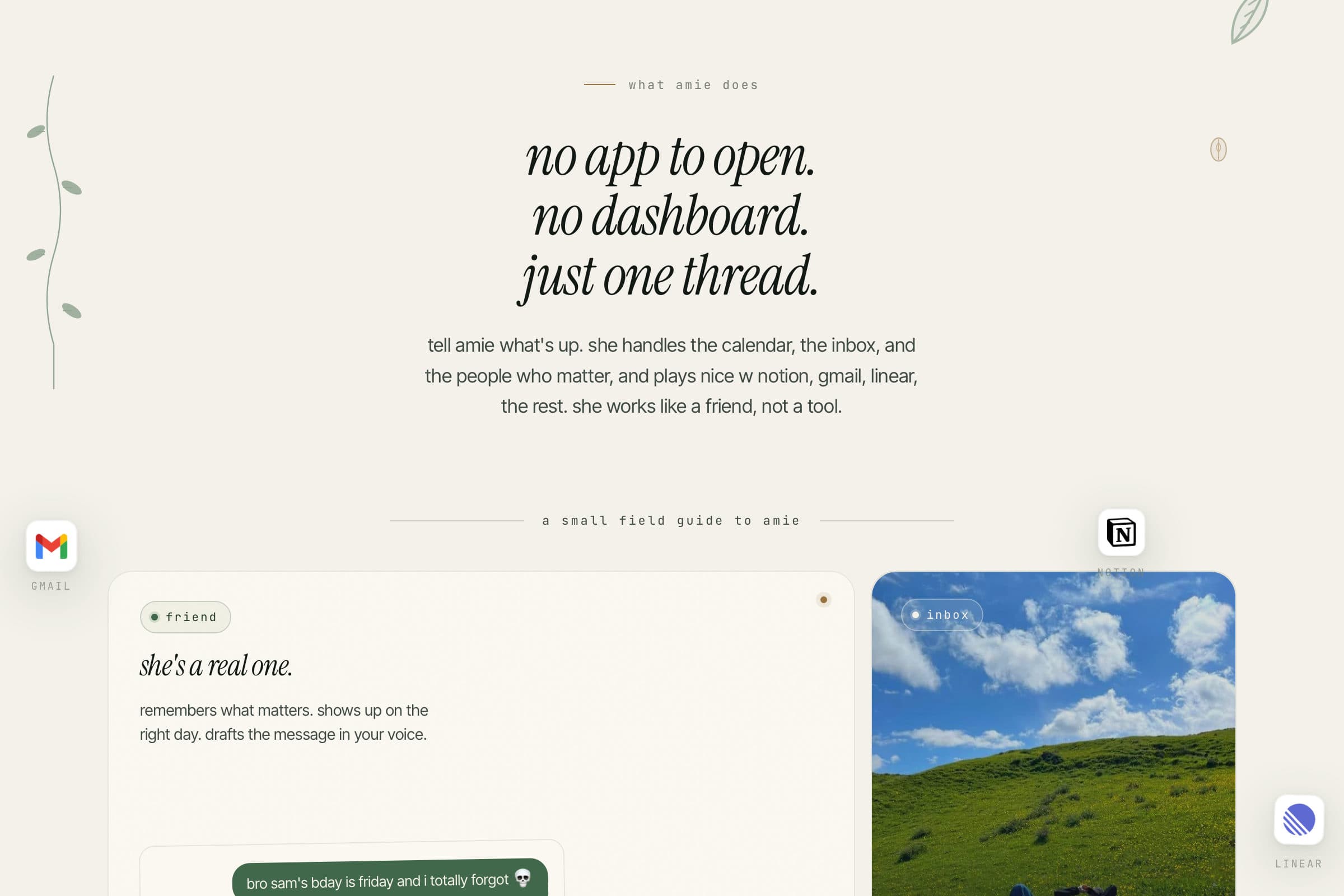
Amie is a messaging-native assistant for iMessage, WhatsApp, and Telegram that acts on your email, calendar, and tools. No new app to open: it meets people where they already talk. The whole site speaks lowercase, in amie's own voice: mon amie, the friend in your texts.
What I built
The agent system, a conversation agent that delegates to persistent execution agents, the FastAPI backend underneath it, and the messaging channels wired end to end.
One message, end to end
One text
Message arrives
iMessage, WhatsApp, or Telegram
FastAPI backend
Conversation agent
reads memory: who you are, what you asked last, how well she knows you
Execution agents
persistent, act on Gmail, Notion, Linear, Slack, and Drive
Reply in the same thread
The split between the two kinds of agent is the load-bearing part. The conversation agent is the one that talks, and it has to answer at the speed of a text message. The execution agents are the ones that do things, and doing things takes as long as it takes: an email sends in a second, a booking might need three steps and a wait. Keeping them separate means the reply never blocks on the work, and the work survives the reply. An execution agent that is still going when the conversation moves on is not a stalled request, it is a background task that will text you when it lands.
A day with amie
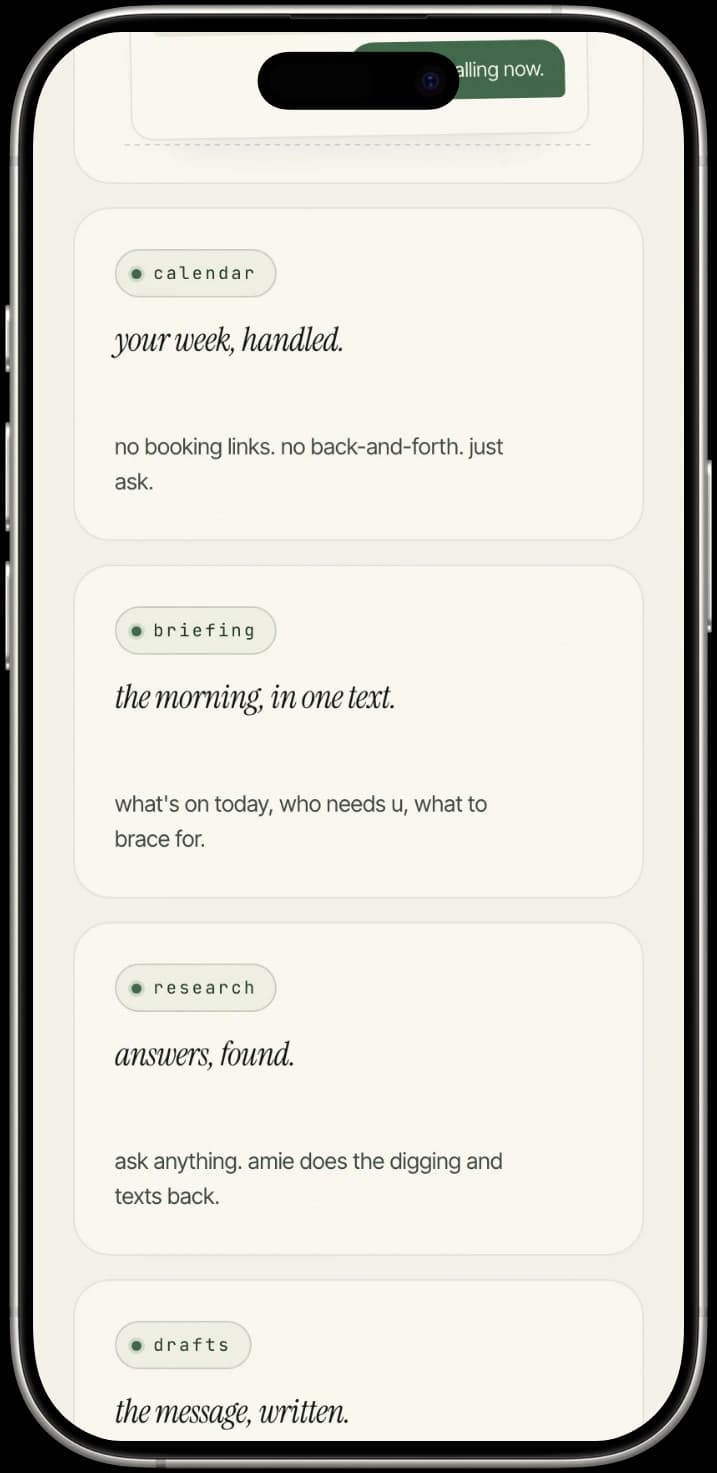
The field guide walks through amie's range as a stack of little cards: calendar (your week, handled), briefing (the morning, in one text), research (answers, found), drafts (the message, written), plus bookings, travel, gifts, promises, and check-ins. She plays nice with Gmail, Notion, Linear, Slack, WhatsApp, and Drive, and it all happens in one thread: no app to open, no dashboard, no login flow, no inbox to maintain.
The interesting problem
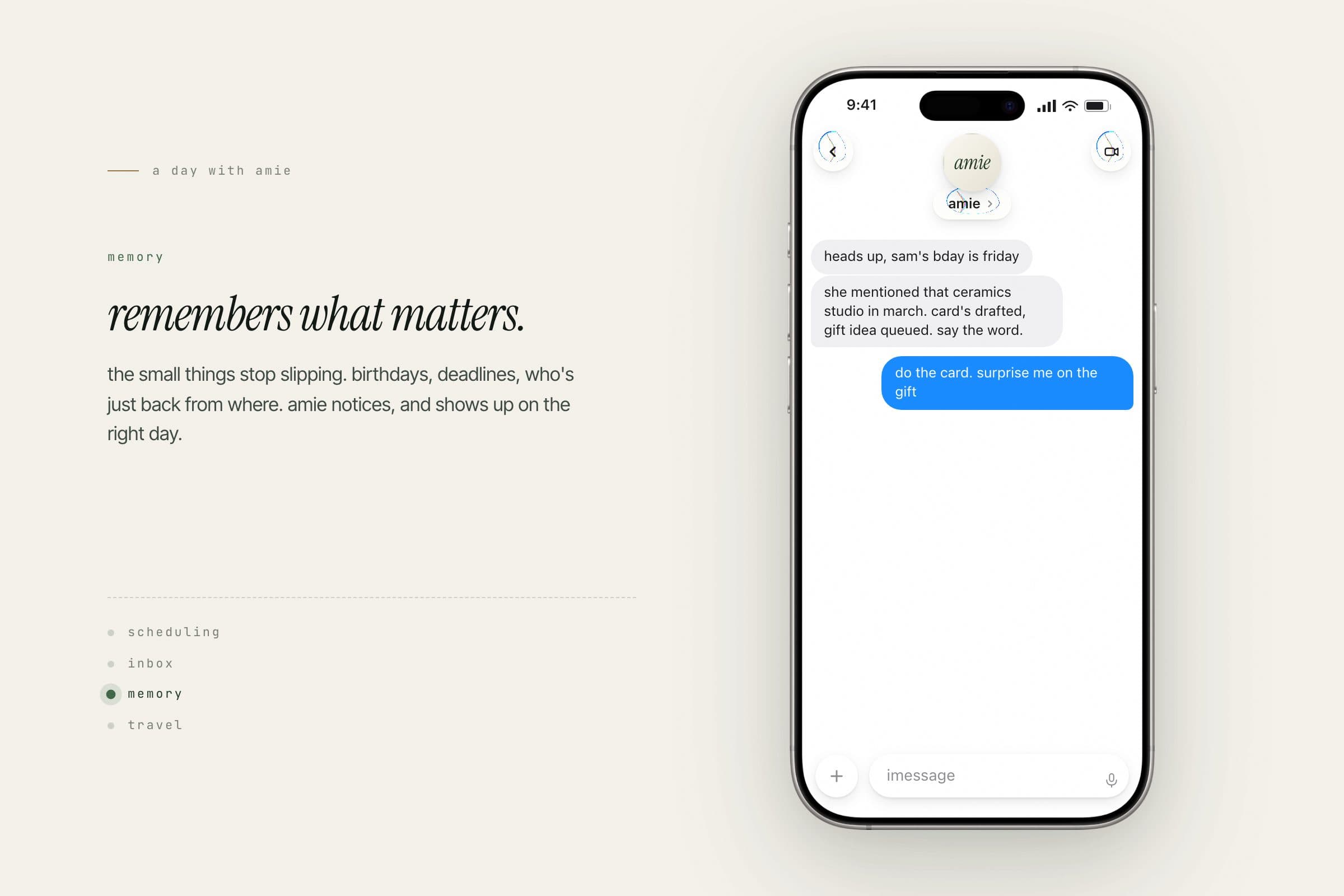
It wasn't the AI. It was making software feel like a friend in your texts, with sass calibrated to how well it knows you. The site calls it the friend layer, not just the task layer: she remembers birthdays, who's back from where, and which novel not to ask about yet.
Calibrated is the whole difficulty. A friend's voice is stateful in a way an assistant's is not. The joke that lands in month three is presumptuous on day one, and the careful formality that is correct on day one reads as distance by month three, so relationship depth has to be something the system actually tracks and conditions on rather than a tone set once in a prompt. Tone tracks relationship depth, so the longer she knows you, the more she sounds like someone who knows you.
That pushes the hard problem down into memory, which is where it has stayed. Remembering a birthday is easy. Knowing which novel not to ask about, that she asked last week and you changed the subject, is a question about what happened and what it meant, not a key-value lookup. The memory layer is the part of Amie still under construction, and it has had its own branch open longer than anything else in the project.
Grown slowly, by hand
Amie is waitlisted, and even the signup is in character: drop your number, no email, no password, amie will just text you. The site signs off the way it lives: grown slowly, by hand.
The next wave of assistants won't be won by the smartest model. It'll be won by whichever one lives where you already are, and Amie is a bet that the smallest, kindest interface, a single message, is still the right one.
Under the hood
Python and FastAPI on the backend, TypeScript on the site.