ProjectsNyxis AI
Nyxis AI
Quiet AI infrastructure for the public sector.
Next.jsTypeScriptTailwind CSSSupabaseAnthropic
Context
Public-sector teams are drowning in inbound: tickets, requests, citizen messages, internal escalations, all aging in queues built for a different decade and a different volume. The result is queue debt, thousands of items sitting in a backlog while real people wait.
Nyxis AI is the answer for cities, campuses, and facilities: an AI-assisted ticketing system that converts unstructured signals, texts, photos, forms, emails, and API calls, into structured, trackable tickets with routing, ownership, and resolution. The site says it in one line: the future of cities runs on AI.
What I built
The product and its public face: intake, triage, prioritization, and assisted response across the queues these teams already run, plus the marketing site that explains it. The site opens on a ring of city photographs that morphs as you scroll, then walks the whole pipeline, signal to structure to action. Deployment specifics are under NDA.
Report it like a text
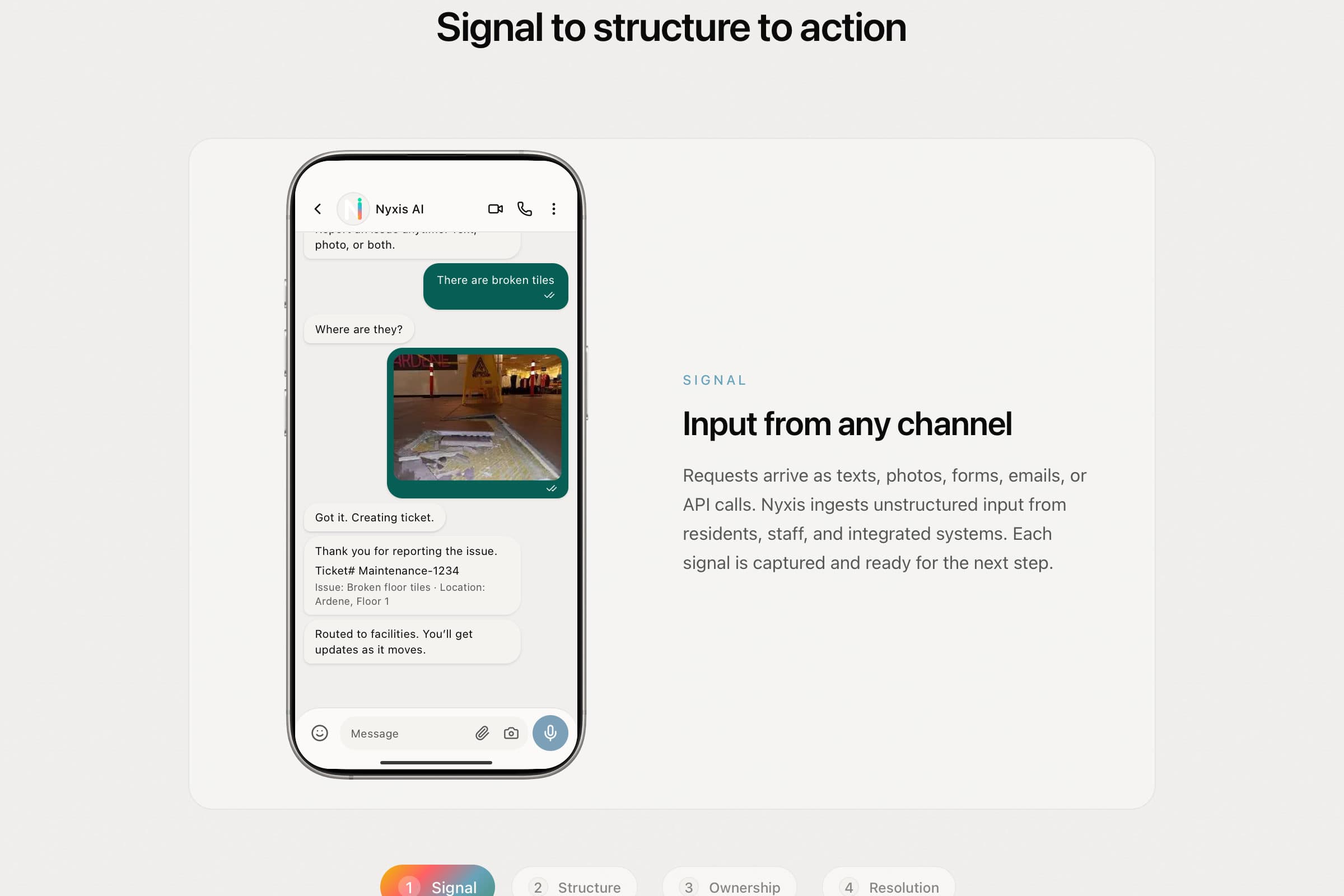
The demo carries the pitch: a resident texts "There are broken tiles", attaches a photo, and Nyxis answers with a ticket, category, priority, location, routed to facilities, with updates as it moves.
Intake
Signal
a text, photo, form, email, or API call, from anyone
Structure
AI classification, category, priority, location, reviewed by a human before routing
Ownership
assigned to a team, tracked, visible to whoever reported it
Resolution
status, notifications, and the full audit trail
Four steps sit under everything, and the third one is the step most tools skip. Classification without ownership produces a tidier backlog, not a shorter one. The interesting claim Nyxis makes is not that a model can read "there are broken tiles" and say facilities; it is that the same object carries a name, a clock, and a record of everything done to it from the moment the text lands.
Built for operations
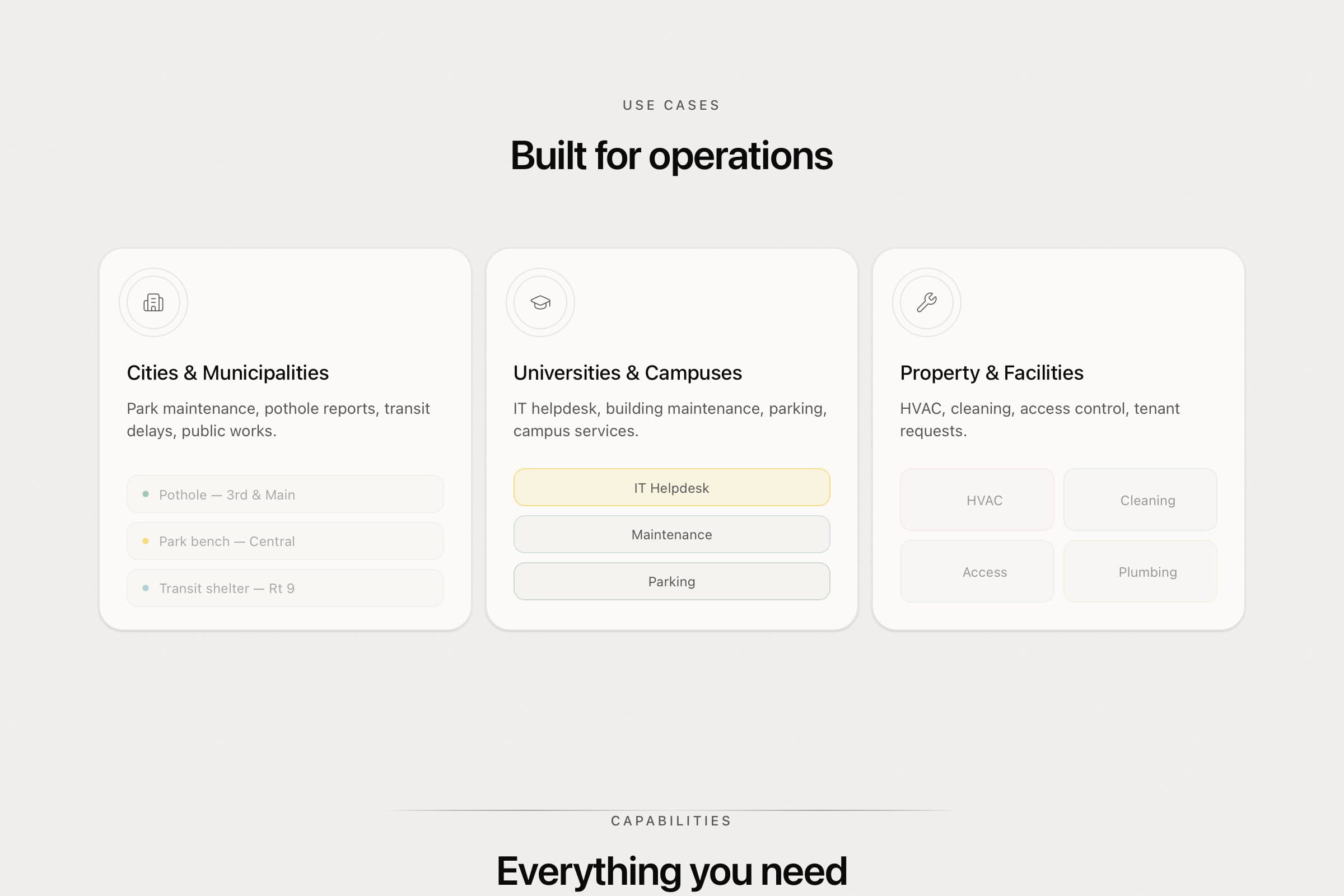
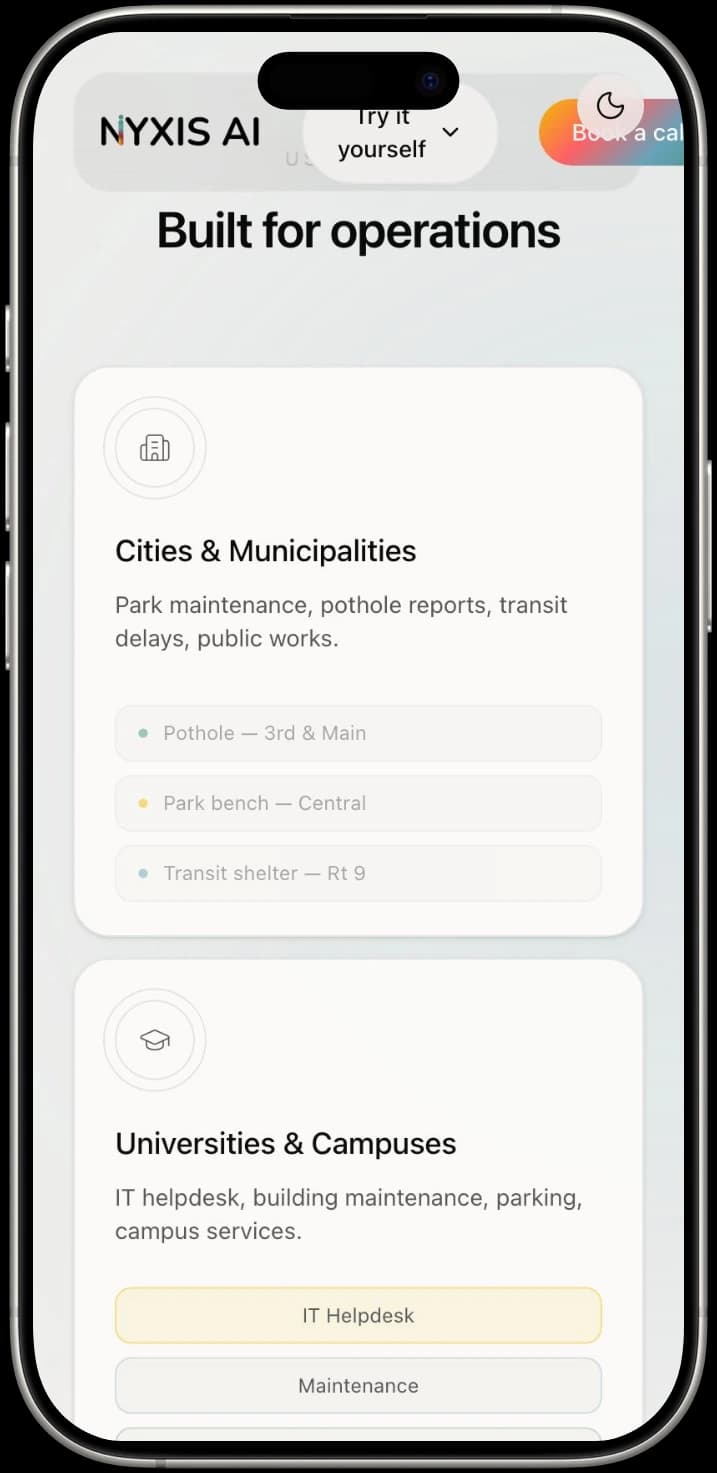
Three rooms, one product: cities and municipalities (potholes, park maintenance, transit delays, public works), universities and campuses (IT helpdesk, building maintenance, parking), and property and facilities (HVAC, cleaning, access control, tenant requests).
They look like three markets and behave like one. Each is a queue fed by people who do not know, and should not have to learn, which department owns their problem. A student reporting a broken door does not know whether that is facilities or security; a tenant with no heat does not know whether HVAC is the landlord's or the building's. Routing is the product in all three rooms, and the categories are the only thing that changes between them, which is why one system can carry a pothole and a parking complaint without either becoming a special case.
Built on trust
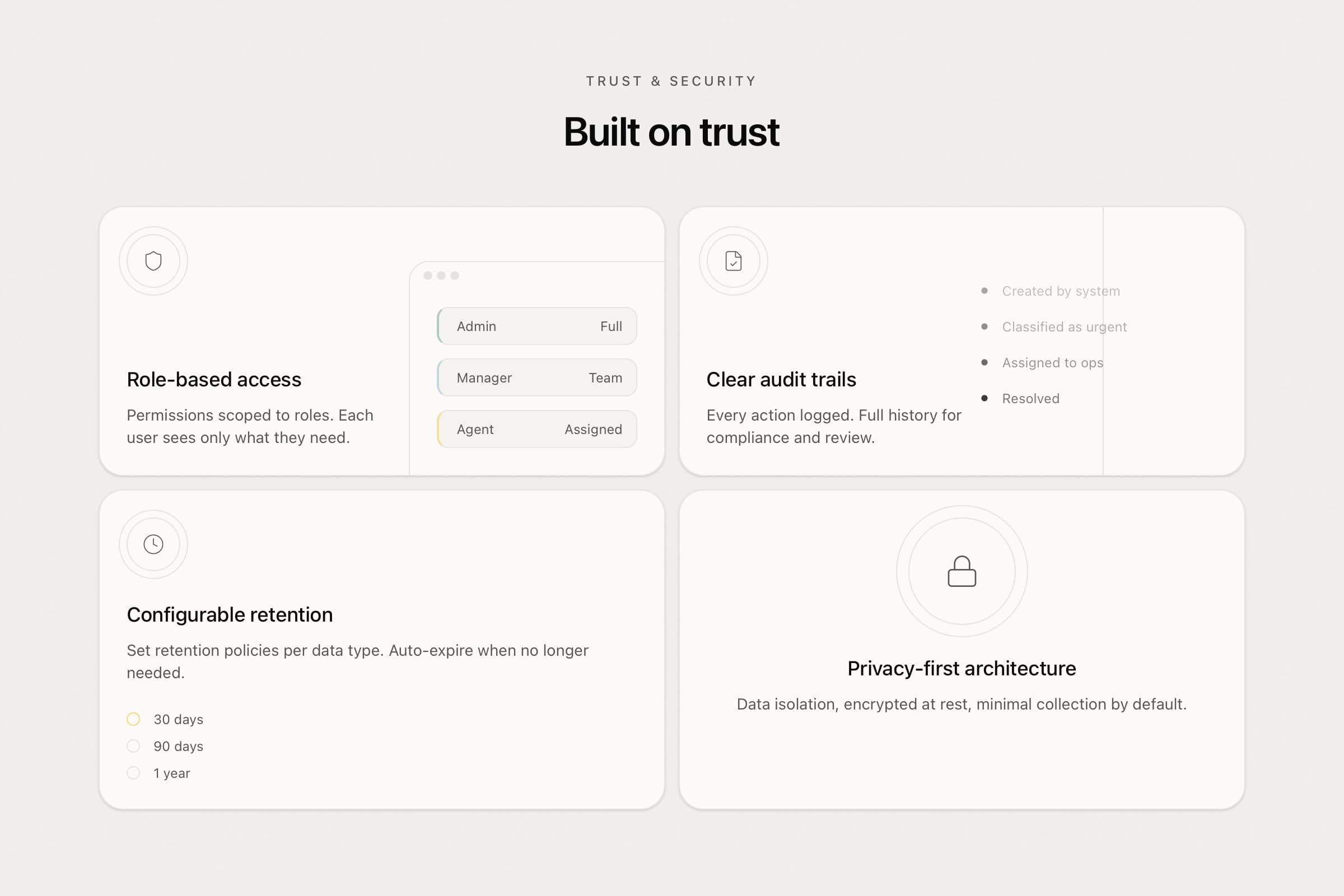
Generic AI tools weren't built for the constraints these teams live with, so Nyxis leads with them: role-based access, clear audit trails with every action logged, configurable retention per data type, and a privacy-first architecture, data isolation, encrypted at rest, minimal collection by default.
Each of those is a procurement question before it is a feature. A public body has to be able to say who saw a record and who changed it, which makes the audit trail load-bearing rather than a compliance checkbox. Retention is configurable per data type because a photograph of someone's front yard and a maintenance ticket number do not deserve the same lifespan, and one global retention setting forces a choice between keeping too much and losing the operational history. Minimal collection by default matters for the same reason: the data you never took is the only data that cannot leak.
The interface is calm on purpose: a muted palette, soft glass surfaces, no aggressive color, and type that reads on a tired Tuesday afternoon. That is a trust decision too. A tool that arrives in a public office looking like a growth dashboard is telling the people who have to use it that it was designed for somebody else. Staff use it without training, and "automation" stops being a charged word.
Under the hood
Next.js, React, TypeScript, and Tailwind, with Framer Motion driving the scroll-tied animation. Supabase and Anthropic models underneath.

Why it matters
Most of the visible AI products of the last two years were built for engineers, marketers, or power users. The people answering tickets at a city office got the same off-the-shelf model with none of the affordances. Nyxis is a bet that the highest-leverage AI work over the next decade isn't consumer chat. It's quietly retrofitting the systems that hold civic life together.
Currently deployed to early partners.