ProjectsLuma
Luma
Conversational AI therapist.
Next.jsOpenAIFirebaseTailwind CSS
Context
Mental health support is expensive and inaccessible for many people. Therapy waitlists stretch for months, sessions cost $150+/hour, and crisis moments don't wait for business hours. Conversational AI can bridge the gap, not as a replacement for therapy, but as an always-available companion for processing thoughts.
Luma is that companion: an AI therapist that uses guided conversation techniques inspired by Cognitive Behavioural Therapy to help someone identify a thought pattern, challenge a cognitive distortion, and work through an emotional moment as it's happening.
One button
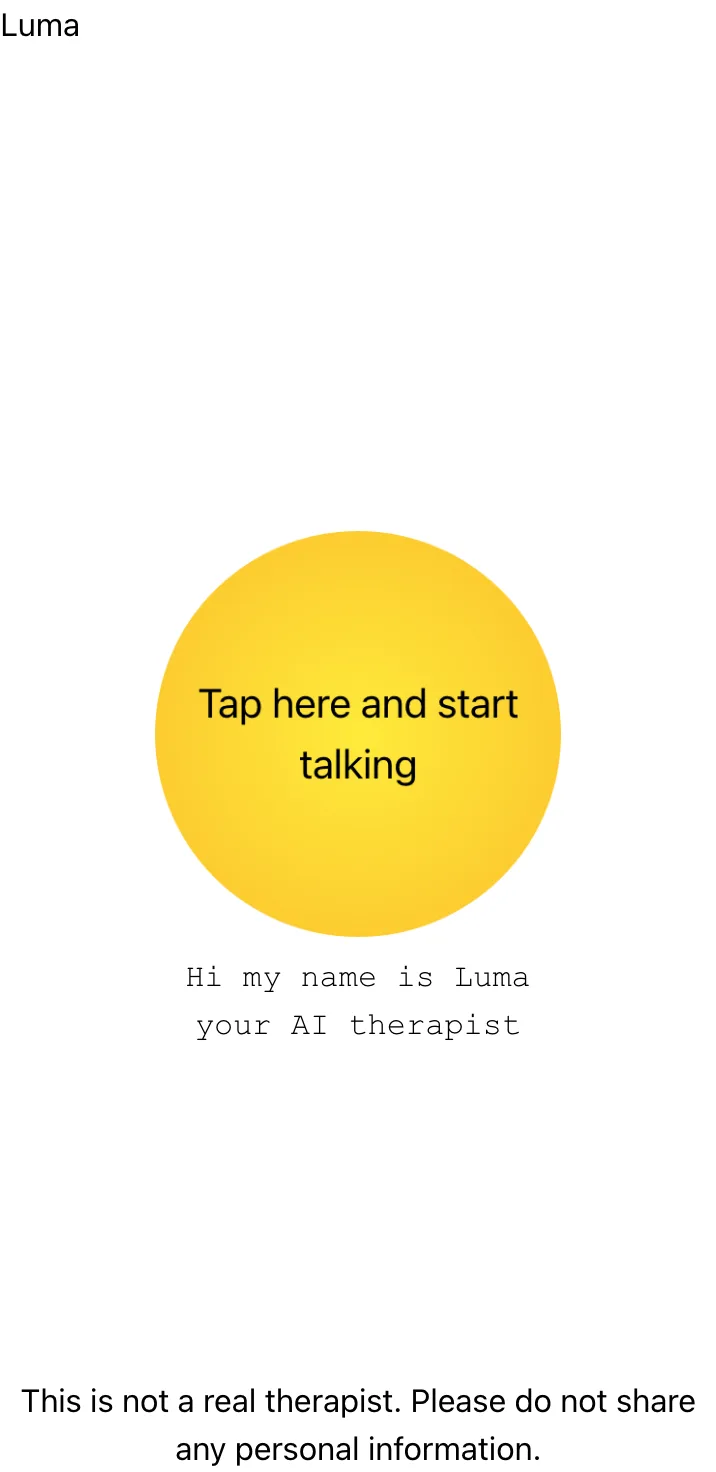
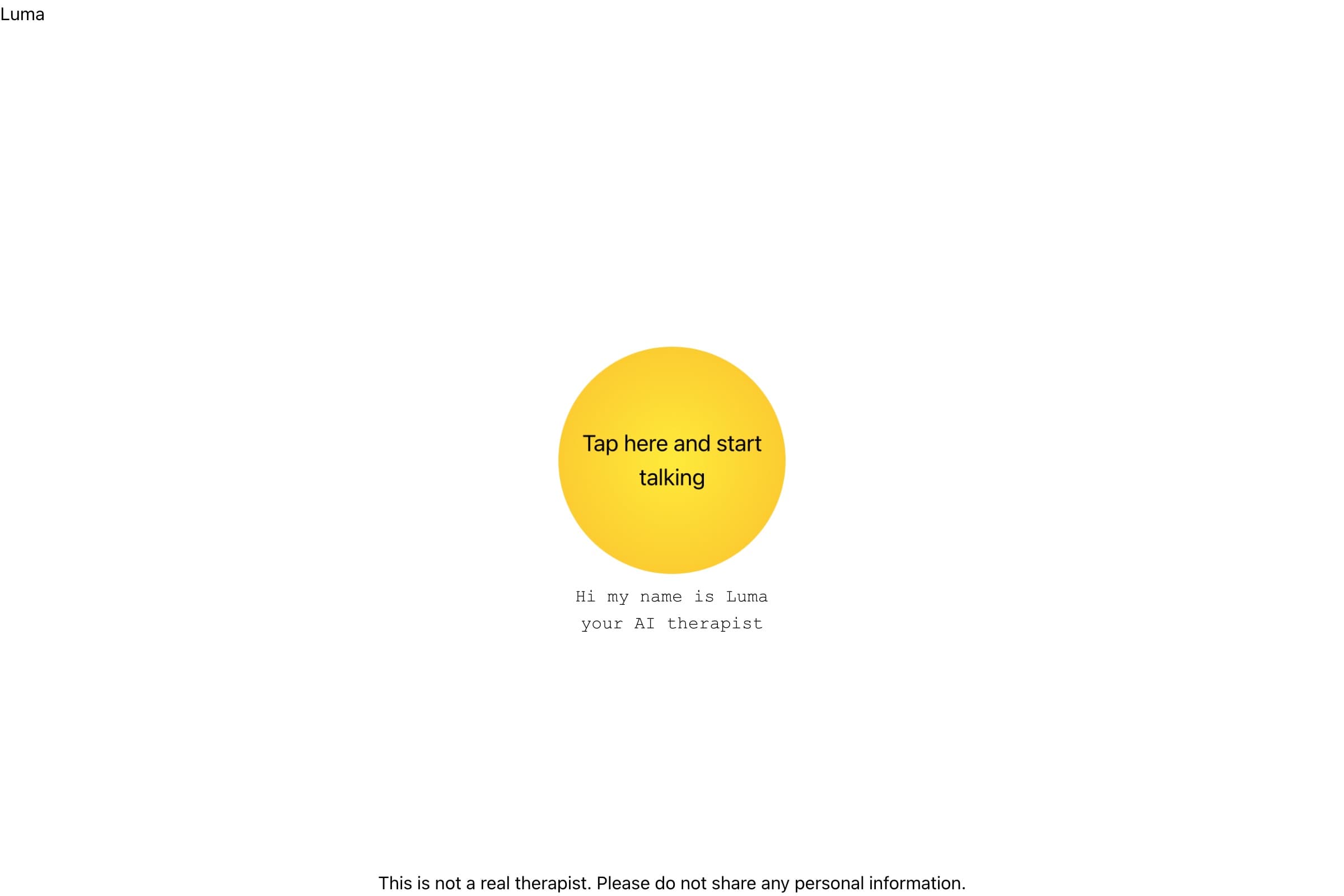
The opening screen is a yellow orb that says tap here and start talking, a line of type underneath introducing Luma, and a disclaimer along the bottom that this is not a real therapist and you should not share personal information. There is no sign-up, no onboarding, no settings page, and nothing to read before you start.
That was the design brief. Someone reaching for this at two in the morning is not going to complete a profile first, and every screen between them and the conversation is a chance to close the tab. The orb is the entire interface on purpose: one affordance, no wrong first move, and no moment where the person has to decide what kind of help they are asking for before they have said anything.
A session, start to finish
A session
Tap the orb
no sign-up, nothing to read first
Name the thought
what happened, and what you told yourself about it
Find the distortion
Socratic questions against the cognitive triangle
Challenge it
a thought record, evidence for and against
Choose one small action
behavioural activation
Close the tab
nothing stored, nothing logged
CBT, not a generic chatbot
Generic therapeutic prompts produce vague, unhelpful answers, so the system prompt is structured around specific frameworks rather than a tone of voice: the cognitive triangle, Socratic questioning, thought records, thought challenging, behavioural activation.
Those are not five names for the same thing, and the order they appear in is the session. The cognitive triangle is the frame, that a situation, a thought, and a feeling are three different objects and only the middle one is negotiable. Socratic questioning is how a distortion gets found without being announced, by asking what the evidence is rather than declaring the thought irrational. A thought record is where the answers get written down side by side, which is the step that does the actual work, because a catastrophic prediction usually survives only as long as nobody asks it to sit next to the evidence. Behavioural activation is the exit, one small thing to do, because a session that ends in insight and no action tends not to change the next day.
Giving the model a concrete methodology is what separates a session that goes somewhere from one that just agrees with you warmly for ten minutes. Warm agreement is what a language model does by default, and it is close enough to support that nobody notices it never asked a single uncomfortable question. Naming the frameworks is what forces the model to push back.
The other half of that work is knowing when to stop. The model has to recognise crisis language, suicidal ideation and self-harm, and respond by surfacing hotline numbers and pushing toward a professional rather than trying to handle it in the conversation. That branch has to outrank everything else in the prompt, because the same instinct that makes a CBT session useful, stay with the thought and examine it, is exactly the wrong move in a crisis. The disclaimer along the bottom of the screen is part of the same design, not legal decoration: the product's most important claim is about what it is not.
Under the hood
Next.js and Tailwind for a deliberately calm interface, with Firebase in the stack behind it. Responses stream rather than arriving as one finished block, which matters more here than in most products: a pause before an answer means something in a conversation like this, and every hundred milliseconds of dead air reads as hesitation.
Sessions are ephemeral by design. Nothing is stored, logged, or retained. That was an architectural decision rather than a feature, on the theory that people are more honest when they know nothing is being recorded, and it deletes an entire category of security and compliance problems on the way past. It also costs something real, and the cost was accepted knowingly: with no history, every session starts cold, and Luma cannot notice that the same thought has come back week after week. For a tool whose whole promise is that you can open it at two in the morning without signing up for anything, that was the right side of the trade.